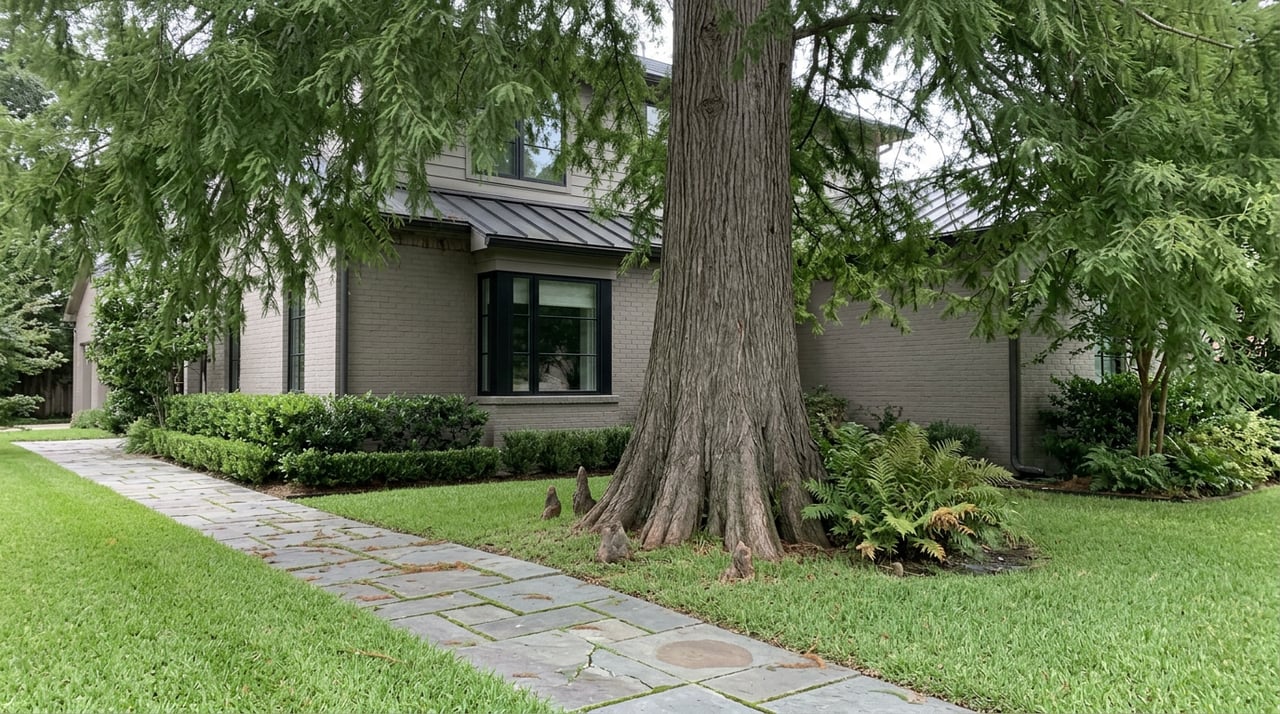
Most Bellaire buyers who plan a teardown assume the tree ordinance is a start-of-project problem: survey the lot, pull a removal permit, plant a few replacements, move on to framing. That is where the paperwork begins, but it is not where the ordinance has its teeth. The City of Bellaire's tree rules follow a project all the way to the finish line, and the city may refuse a certificate of occupancy at the very last step. A buyer who treats tree compliance as a permit to check off in month one can still find themselves unable to close out the project in month fourteen.
That distinction is worth understanding before you sign a construction contract on a Bellaire lot, not after.
The Loophole the City Closed in 2024
Bellaire's tree protections are not new, but their reach expanded in 2024. Before that year, the city's rules protected existing trees on residential property only if a construction permit had already been issued, which meant a property owner clearing a lot ahead of any formal building application could remove mature trees without triggering the ordinance at all. City Council closed that gap on May 6, 2024, with a 5-1 vote, Mayor Gus Pappas the lone no, adopting Ordinance No. 24-025 and a companion Criteria Manual for Urban Forest. Travis Tanner, the city's Director of Development Services, brought the recommendation to Council, and the model the city leaned on was its neighbor's: West University Place's Urban Forest ordinance, which had been in effect for roughly thirty years by that point.
The rewrite matters for anyone buying an older Bellaire lot with the intent to build new. Protection no longer waits for a permit application. It applies to remodeling, demolition, and lot clearing, and it also applies to existing protected trees on property where no construction is happening at all.
What Actually Counts as Protected
The ordinance draws a line at trunk diameter. Removing a tree with a caliper greater than four inches generally requires a tree removal permit, whether the property is residential, commercial, or institutional. Trees measuring six inches in diameter or more are classified as large trees and receive additional scrutiny under the Criteria Manual, since these are the specimens the city considers foundational to the streetscape rather than replaceable in any short timeframe. A small number of exceptions exist. Species listed on the Texas A&M Forest Service's roster of invasive plants can come out without a permit, as can trees a landscape architect, horticulturist, or similarly qualified professional certifies as diseased, dying, or hazardous.
For anything else, the property owner or builder has to produce a tree disposition plan, essentially a survey documenting each tree's location, caliper, and species, along with what will be removed and what will be replaced. That plan gets reviewed by the city's contracted urban forester before construction protection fencing goes up around anything meant to survive the build.
The Money That Doesn't Show Up in the Construction Estimate
None of this is theoretical when it comes to the invoice. The City of Bellaire's Fiscal Year 2026 Schedule of Fees and Charges, adopted September 15, 2025 and effective October 1, 2025, prices out the permit stack separately from the tree work itself; Harbert Group breaks down the listed fees and how the two interact.
| Item | FY2026 Fee |
|---|---|
| Residential demolition permit | $268 flat |
| Tree disposition plan review (heritage trees affected by demolition) | $260 |
| New construction permit, first 4,000 sq ft | approximately $3,193 |
| Floodplain development permit | $447 |
| Drainage review | $384 |
| Certificate of occupancy | $212 |
The table lists several city permit fees; trade permits for electrical, plumbing, or mechanical work are additional. Hard construction costs generally run $250 to $400 per square foot in the current Bellaire market, meaning a 4,000 square foot custom build lands in the neighborhood of $1 million to $1.6 million before land and soft costs. The permit line items are small by comparison, but they are not optional, and the tree disposition review fee in particular is one buyers moving in from outside the city rarely anticipate.
Why the Certificate of Occupancy Is the Real Pressure Point
Here is the part that catches people off guard after they have already spent the money and built the house. The ordinance gives the city several enforcement tools for a tree violation, including fines of up to $500 per occurrence per day for removing protective fencing or storing materials inside a tree's protected root zone, and up to $500 per occurrence for taking down a tree the disposition plan designated to remain. Those fines get deposited into the Bellaire Forestry Enhancement Fund, the account the city uses to plant trees on public property.
But the fine is not the leverage that actually stops a project. Among the enforcement actions available to the city for a violation is the option to refuse to grant a certificate of occupancy. That means a builder can pass every trade inspection, finish the interior, and still be unable to legally occupy or sell the finished home if a tree condition from eighteen months earlier was never resolved. And the obligation doesn't end when the last inspection is signed off, either: any replacement tree that dies within its first two years of planting has to be replaced under the ordinance, which means the disposition plan is a live commitment that outlasts the construction schedule itself.
For a buyer financing a build on a tight timeline, that is a very different risk profile than a $260 fee suggests on paper.
Each protected tree to be preserved must be fenced during development or predevelopment activity.
That single requirement, straight from the ordinance's fencing section, is the kind of detail that gets skipped when a general contractor is juggling a dozen trades on a tight Bellaire lot. It is also the kind of detail a code enforcement officer checks first.
Remember Which City You're Actually In
It helps to keep in mind that Bellaire is not a Houston neighborhood in the administrative sense. It is a fully incorporated home rule city of roughly 17,000 residents, encircled entirely by Houston but running its own Development Services department, its own building official, and its own adopted building codes, including the 2024 edition of the International Codes and the 2023 edition of the National Electrical Code. Setback, lot coverage, height, and tree preservation rules are set at the city level, not the county or the surrounding city, even though every Bellaire address reads Houston, TX 77401. Anyone assuming Houston's rules apply because the mailing address says so is working from the wrong rulebook.
What This Means If You're Under Contract on a Bellaire Teardown
A few things worth locking in before your builder pours a slab:
- Get the tree survey and disposition plan drafted before you finalize the house footprint, not after. Tree locations can constrain buildable area more than setbacks do on a mature lot.
- Confirm with the city's Development Services office that your disposition plan has cleared review before you count on scheduling your certificate of occupancy inspection.
- Budget the listed permit fees separately from hard construction costs, and account for trade permits for electrical, plumbing, or mechanical work, since it is easy for a builder's estimate to blur the two together.
- Ask your builder directly how they plan to satisfy the two-year replacement survival requirement, since that obligation follows the project past the closing table.
A Few Direct Questions
Does the ordinance apply if I'm remodeling rather than tearing down? Yes. The ordinance's own definition of remodeling covers any modification to an existing structure that would require a building permit, and that triggers the same tree removal permit requirements as new construction.
Can I remove a tree without a permit if it's already dead or dangerous? In most cases, yes, provided a landscape architect, landscape designer, horticulturist, or similarly qualified professional documents the condition for the city.
Is there an alternative to replanting a removed tree on-site? The ordinance allows a fee-in-lieu option for owners who cannot meet on-site replacement requirements, with the payment directed into the Bellaire Forestry Enhancement Fund.
Bellaire's tree rules are not a reason to avoid a teardown project, and plenty of buyers move through the process without incident. But the ordinance rewards buyers who plan for it early and penalizes the ones who treat it as paperwork to handle later. If you are weighing a Bellaire lot against a renovation candidate, or trying to understand what a specific parcel's tree canopy will actually cost you in permits and timeline, Austin Oztan can walk through the numbers on a specific property before you're under contract. Schedule a consultation to talk through what a particular lot will actually require.
This article is general information, not legal, tax or financial advice. Consult a qualified professional about your situation.