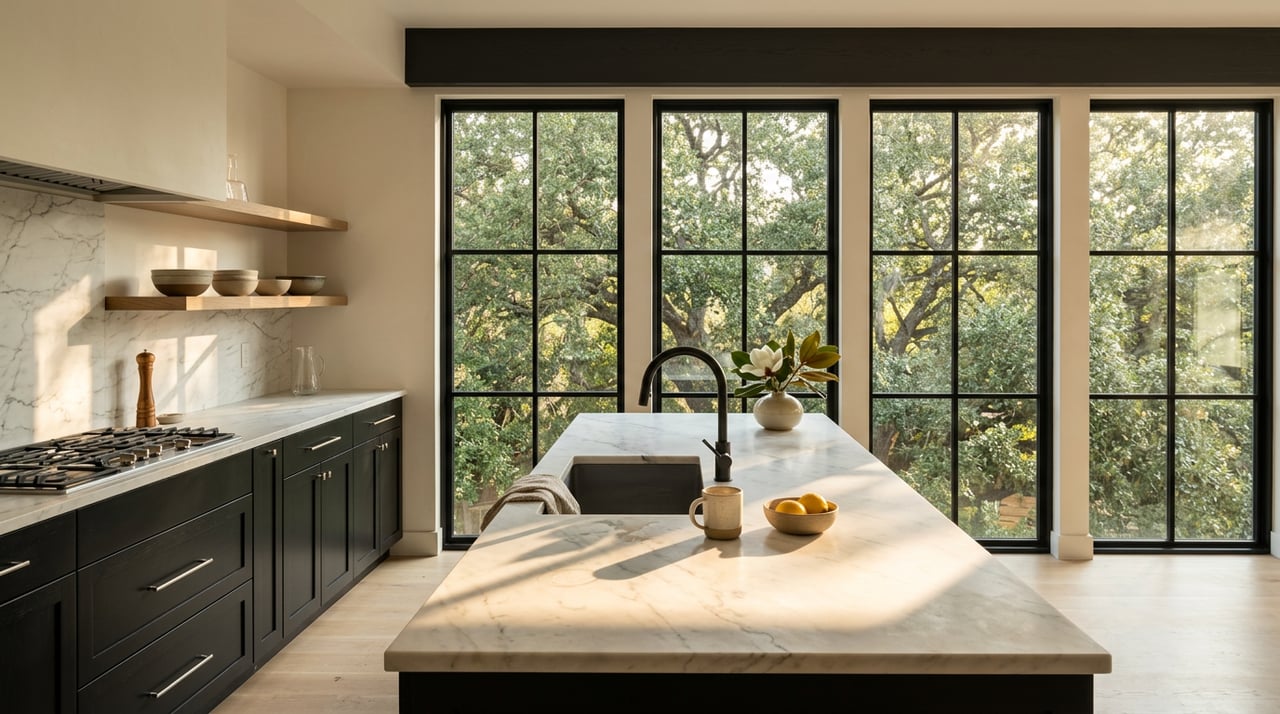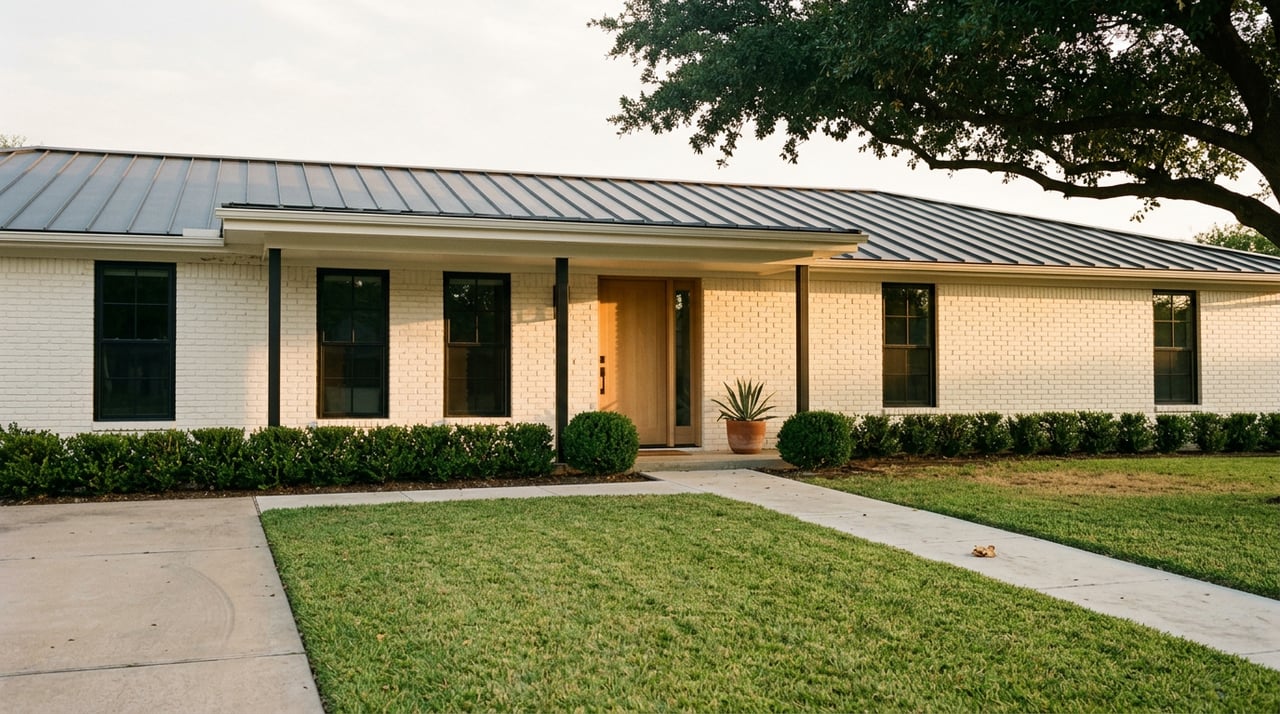
Two houses sit three doors apart on a street off Blalock. One is a 1958 ranch with a carport and original windows. The other is a four-bedroom new build with a two-car garage and 12-foot ceilings. The ranch trades for what the dirt is worth to a builder. The new build closes north of $750,000. Both are "Spring Branch comps." Neither one tells a buyer what Spring Branch actually costs.
This is the mechanic that portal medians cannot show you. Spring Branch is not one market. It is two overlapping auctions running on the same inventory, and the price a specific house commands depends on which auction it belongs to.
The median is a blended average of two different auctions
The headline numbers for 2026 look orderly. The median home price sits near $365,000 across the neighborhood, and active listings for single-family homes jumped 15.2% year-over-year as of February 2026. Days on market are stretching. The Houston market is currently seeing its highest "Days on Market" (69 days) since 2013, meaning buyers finally have a bit more time to breathe and negotiate.
Read that as a single market and Spring Branch looks like a cooling suburb. Break it apart and the picture changes. Most homes in Spring Branch currently trade between roughly $400,000 and $900,000, while new construction commonly ranges from the $750,000s to $1.3M+ depending on size, location, and school zoning. Smaller-lot infill sits lower. In Spring Branch, smaller-lot new construction is appearing around the mid-$300,000s to mid-$400,000s, while larger detached new builds on roughly 10,000-square-foot lots are listing around $1.4 million to $1.5 million.
The distribution is not a bell curve around $365,000. It is a barbell. And the reason is that two different buyers are pricing the same street.
Who is bidding, and on what
The friction that catches buyers off guard in Spring Branch is that the person competing with them for a listing is often not another family. It is a builder pricing the land.
| Buyer type | Values | Ceiling set by |
|---|---|---|
| End-user family | House condition, layout, move-in readiness | Comparable renovated or new homes nearby |
| Renovation investor | Bones, footprint, cost to update | Post-renovation resale minus rehab budget |
| Builder or developer | Lot size, width, depth, subdivision math | Sellout of new construction on that block |
The builder wins when the numbers on the dirt beat the numbers on the house. Houston's lack of zoning means many Spring Branch lots can be subdivided. A 10,000 SF lot could potentially support two new homes. If your lot has subdivision potential, a builder might pay more for it than a homeowner would pay for the house.
That is the sentence that reframes the whole neighborhood. Two comparable ranch homes on the same street can sell at meaningfully different prices because one sits on a 6,200-square-foot lot that no builder can carve up and the other sits on a 10,400-square-foot lot that supports two new detached homes. The house is nearly irrelevant to the second transaction.
The pace of new construction in Spring Branch has been remarkable. Blocks that were entirely 1950s-60s ranch homes five years ago now have a mix of original homes and new builds. This transition phase creates pricing complexity, your comps might include a teardown that sold for lot value and a new build that sold for $750K on the same street.
What Greenside is doing to the price-per-foot gap
Location-driven demand in Spring Branch has been steady for years because of the commute geometry. Positioned largely inside the Beltway, the neighborhood provides efficient access to the Energy Corridor, Memorial, The Galleria, and Downtown. Many residents experience shorter or reverse commutes compared with other parts of Houston, which remains a key driver of demand.
What is different in 2026 is that the retail and gathering-place infrastructure is catching up to the commute. Greenside is the clearest signal. MetroNational and Radom Capital announced the first wave of tenants at Greenside, a redevelopment of industrial buildings into a neighborhood gathering place serving families in west Houston's Spring Branch and Memorial. Located on the north side of I-10 at 1085 Gessner Road, Greenside will add 35,000 SF of dining, wellness, and beauty-oriented businesses adjacent to a community hub established by MetroNational in 2020. The project was designed by Michael Hsu Office of Architecture, Greenside broke ground last year next to Kirby Ice House, Mia's Table, and Torchy's Tacos. The new tenants will include Honest Mary's, Leemoo, Hiatus, and [solidcore]. According to the Houston Chronicle, Greenside is already 75% leased.
The mechanism to watch is the price-per-square-foot spread between Spring Branch and the neighborhoods buyers use as comps. When buyers compare price per square foot to nearby high-demand areas such as The Heights or Memorial Villages, Spring Branch often stands out as a value opportunity that still delivers proximity and lifestyle. Memorial Villages, one block of that comparison, is not close. HAR's Memorial Villages market area reported a March 2026 median sold price of $2,535,120 and an April 2026 seller's market with 3.4 months of inventory.
New retail like Greenside does two things to that spread at once. It gives builders a reason to underwrite higher sellout prices on new construction, which raises what they will pay for land. And it gives end-users a reason to accept a higher price per foot for a renovated home, which raises the ceiling on renovation plays. The gap narrows from both sides. Buyers who wait for the median to catch up are watching the wrong indicator.
The lot questions that actually decide the transaction
If the neighborhood median is the wrong anchor, the right anchor is a lot-specific analysis. The questions worth answering before writing an offer are not about the house.
Subdivision geometry. Width, depth, and shape control what a builder can do more than raw square footage. A long, narrow 9,000-square-foot lot supports different math than a square one. A lot can look attractive on paper and still fall short once you study the build envelope. In this part of the market, size alone is not enough. Width, depth, shape, easements, and drainage can all affect what you can realistically do.
Deed restrictions. Houston has no zoning, but private restrictions do the work zoning does elsewhere, and they are not uniform. In Houston, deed restrictions can vary by subdivision, section, or even lot. That means you need a property-specific review rather than broad assumptions based on the surrounding area. Two houses across the street from each other can have very different redevelopment paths.
Flood status. Harris County says floodplain status should be checked through official floodplain resources and, when needed, a floodplain consultant. The county also notes that even properties outside a designated flood hazard area may still warrant flood insurance consideration.
The block's transition stage. Some Spring Branch blocks have fully transitioned to new construction. Others still have mostly original homes. Where your property sits on that spectrum affects buyer perception and pricing. A renovated home surrounded by other renovated homes prices differently than one surrounded by teardowns and active construction sites.
The absence of an HOA. No HOA in most areas. Unlike master-planned suburban communities, most of Spring Branch doesn't have HOA oversight. This is a selling point for some buyers and a concern for others. It means more freedom but also means you can't control what your neighbor does with their property. In a block still mid-transition, that matters for resale timing.
The MUD question. Unlike many suburban communities outside Houston, most established sections of Spring Branch do not carry a MUD (Municipal Utility District) tax. This can positively affect total cost of ownership.
Where this friction shows up in the transaction
The dual-buyer pool creates specific pressure points that do not exist in a market with a single audience.
Appraisals get messy on transitional blocks. When a comp set contains a teardown, a renovated ranch, and a new build within 500 feet, the appraiser is choosing which market to price the subject against. Contracts that assume the renovated ranch is the correct comp can encounter appraisal gaps that would not appear in a more uniform neighborhood.
Marketing decisions have to pick a buyer. This creates a dual market. End-user buyers, families, young professionals, downsizers, are shopping for move-in-ready homes. Builders and developers are shopping for lots. In some cases, your property appeals to both. In others, understanding which group is your most likely buyer determines your strategy. A home marketed to families that should have been marketed to builders leaves money on the table, and vice versa.
Days-on-market averages mislead sellers of both types. A move-in-ready home on a small lot in a fully-transitioned block sells quickly. A tired home on a large lot in a still-transitioning block often takes longer because the buyer pool is builders, and builders write fewer offers per listing than families do. The 69 days average conceals both experiences.
Investors who track this market are already positioned. Houston remains a strong flip market, particularly in the $150,000-$300,000 ARV range. The median flip profit in Harris County has compressed from the pandemic highs but still sits around $35,000-$50,000 per deal for well-executed projects. The best flip opportunities in 2026 are in transitioning neighborhoods where renovation brings a property up to the standard of surrounding recently upgraded homes. Areas like Garden Oaks, Oak Forest, parts of the East End, and sections of Spring Branch are seeing renovation activity that supports higher ARVs.
The neighborhood context around all of this keeps expanding. Earlier phases of the transition brought the Witte Road Redevelopment project, converting a former 1.53-acre warehouse on Witte and Westview roads into a neighborhood hotspot for dining and retail. The development features two flagship Underbelly Hospitality concepts, Wild Oats and Underbelly Burger, alongside The Decoy, an expansive outdoor bar with sand volleyball courts. Public infrastructure is following. The initial phase, finalized in 2020, introduced the 2.4-mile Spring Branch Trail, with the second phase set to expand upon this trail once nearby utility tower work concludes. Haden Park is being rebuilt with an event lawn, dog park, splash pad, tree house, pickleball courts, playgrounds and public art installations. Each new amenity is a small upward tick in what a builder can underwrite for a new home's sellout price, which flows straight back into what land is worth today.
FAQ
If two buyer pools price the same house, how do I know which comp to trust? Look at the lot. If the subject's lot is under roughly 7,000 square feet or has geometry that blocks subdivision, the correct comp set is renovated houses. If the lot is 7,000-plus and buildable, builder-paid comps belong in the set even if the house itself is livable.
Is a smaller, newer townhome a better value than an older ranch on a big lot? They are different assets. The townhome prices like a house. The ranch prices like optionality. In a slower market the townhome is easier to resell. In a rising market the ranch captures land appreciation the townhome cannot.
Does Greenside actually change what I should pay today? It changes what a builder will pay for a nearby lot today, because sellout underwriting incorporates future amenities. For an end-user buyer of a finished home, the effect is slower and closer to a lift in resale confidence than a jump in price.
Spring Branch rewards buyers who read the block, not the neighborhood. If you are weighing a specific property and want a lot-level analysis before you write an offer, Austin Oztan brings 25-plus years of Houston investor, brokerage, and MBA-trained financial perspective to that review. Schedule a Consultation to talk through the property, the block, and the number that actually matters.